IELTS in 2026: Computer-Based Testing, New Result Forms and Major Updates Candidates Need to Know
IELTS candidates have seen several important developments in 2026, from the global shift toward computer-delivered testing to changes in Test Report Forms and fresh research into what matters most to people planning to study, work, or migrate abroad. For candidates in Bangladesh, one of the biggest changes has already happened: the traditional IELTS on Paper test is no longer offered through IDP Bangladesh. Meanwhile, internationally, IELTS is continuing its broader transition toward computer delivery while introducing a handwriting option for the Writing test in selected markets.
IELTS Is Moving Away From the Traditional Paper-Based Test
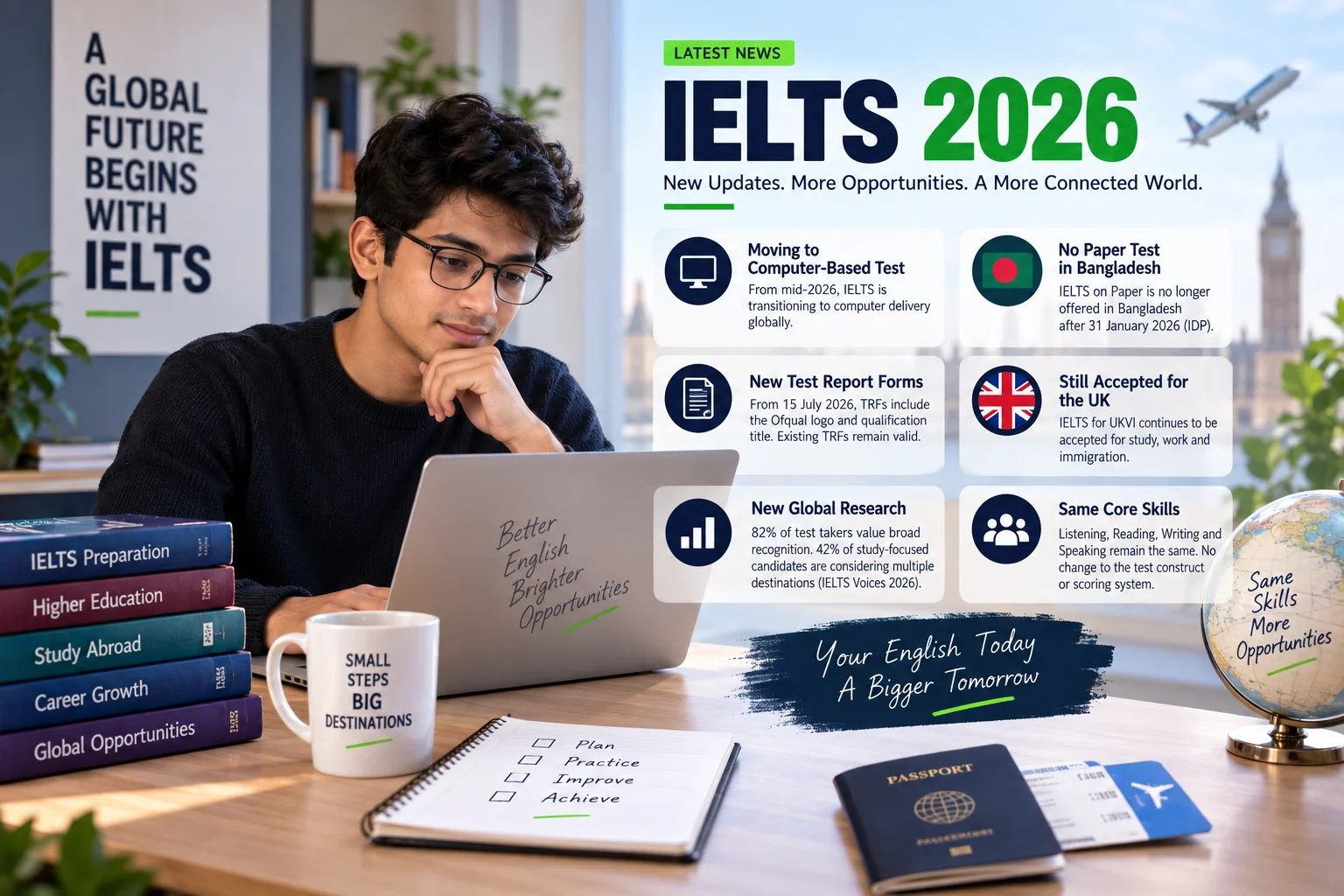
Perhaps the most significant announcement of the year came on March 5, 2026, when IELTS confirmed plans to move away from the traditional paper-based test.
IELTS announced that, beginning from mid-2026, its tests would transition to computer delivery, although the exact implementation timeline would differ from one country or market to another.
There are several practical reasons behind the move.
According to IELTS, candidates taking IELTS on computer have reported benefits including greater convenience, faster results and access to services such as One Skill Retake.
For students who have spent years preparing with pencils, printed Reading passages and handwritten answer sheets, the change means computer familiarity is becoming an increasingly important part of IELTS preparation.
Candidates should now become comfortable with:
reading longer passages on a screen
typing Writing Task 1 and Task 2 responses
navigating between questions
entering answers accurately on a computer
managing their time while working digitally
However, IELTS has stressed that moving to computer delivery does not mean candidates are facing a completely new exam.
The skills being tested remain the same.
Bangladesh Has Already Made the Switch
For IELTS candidates in Bangladesh, the transition is particularly important.
IDP IELTS Bangladesh states that IELTS on Paper stopped being offered in Bangladesh after January 31, 2026, with candidates moving to IELTS on Computer instead.
This means Bangladeshi candidates preparing from old books or watching older IELTS preparation videos should be careful.
The English skills taught in those resources may still be completely useful, but candidates should also practice under the test-day format they are actually going to experience.
Someone who can write an excellent essay by hand, for example, may still lose valuable time if they are uncomfortable typing under pressure.
Similarly, Reading practice should increasingly include reading and locating information on a screen rather than relying entirely on printed passages.
The lesson is simple:
IELTS preparation in Bangladesh should now include computer-test practice as a standard part of preparation, not as an optional extra.
Prefer Handwriting? IELTS Is Introducing “Writing on Paper”
Interestingly, IELTS is not completely abandoning handwriting.
For candidates who prefer writing essays by hand, IELTS has introduced a new format called Writing on Paper in selected countries.
Under this option, Listening and Reading are completed on computer. The Writing questions are also displayed on the computer screen, but candidates receive an IELTS Writing Answer Sheet and complete their answers by hand.
IELTS says the:
Writing task types remain the same
scoring remains the same
time allocation remains the same
The main difference is simply whether the candidate types or handwrites the Writing responses.
Research conducted before the rollout also found that scores were effectively comparable between the formats.
However, availability depends on the country and test centre, so candidates should check the options available when booking rather than assuming Writing on Paper will be offered everywhere.
There is another important exception: Writing on Paper is not available for IELTS for UKVI.
IELTS Test Report Forms Changed in July 2026
There has also been an administrative change to IELTS results.
IELTS announced that from July 15, 2026, Test Report Forms, commonly known as TRFs, would be updated to comply with requirements from Ofqual, England's regulator for qualifications, examinations and assessments.
The updated forms now include:
the Ofqual logo
the Ofqual qualification title
The change does not mean that older valid IELTS results suddenly became invalid.
IELTS has explicitly stated that Test Report Forms issued before and after the change remain valid for purposes such as university and visa applications.
Candidates who received a TRF between June 2024 and July 14, 2026 can also request an updated version containing the new Ofqual information, although IELTS says doing so is optional.
So if your IELTS result still falls within the period accepted by the institution receiving it, you should not assume that you need to take the exam again simply because your TRF looks different from a newly issued one.
IELTS Remains Accepted for UK Visa and Immigration Purposes
There was also significant news for candidates planning to move to the United Kingdom.
On March 26, 2026, IELTS confirmed that UK Visas and Immigration had extended its agreement recognizing IELTS as an approved Secure English Language Test provider.
As a result, IELTS for UKVI Academic and IELTS for UKVI General Training continue to be accepted as proof of English ability for relevant applications to study, work or live in the UK.
This is particularly important because IELTS had announced earlier in March that it would not participate in a separate UK Home Office procurement process for a proposed fully remote English-language immigration test.
That earlier announcement did not mean IELTS had immediately stopped being accepted by UKVI. The March 26 confirmation made clear that IELTS continues as an approved option under the existing Secure English Language Test arrangements.
Candidates should nevertheless always check the exact English-language requirements for their specific visa route before booking a test.
New Research Shows Candidates Care Most About Global Recognition
The latest major IELTS announcement arrived on September 7, 2026.
IELTS partners published findings from IELTS Voices, a survey involving 8,395 current and prospective English-language test takers across 165 countries.
The research found that 82% of respondents prioritize choosing an English-language test that is recognized as broadly as possible.
That finding reflects an important change in international education.
Students are increasingly considering multiple countries rather than building their entire future around a single destination.
Among respondents taking IELTS for study purposes, 42% said they would consider more than one study destination.
The research also found that candidates were more than twice as likely to prefer having a choice between government-approved English tests rather than being required to take one single government-mandated test.
Interestingly, cost was not the only major concern.
According to the survey, 89% said successful outcomes were equally or more important than selecting the cheapest test option.
The research also suggests that IELTS preparation itself may have benefits beyond earning a band score. Around 67% of respondents reported improvements in speaking confidence, academic or professional writing, or both, as a result of preparing for IELTS.
Has the IELTS Scoring System Changed?
This is likely to be one of the biggest concerns for students.
The major 2026 announcements discussed here do not represent a replacement of the familiar IELTS band-score system or a completely redesigned examination.
The shift toward computer delivery concerns how the test is delivered, not a fundamental replacement of the language skills being assessed.
IELTS specifically states that the transition does not change:
the skills assessed
the test construct
how results should be interpreted by institutions
The Writing on Paper option similarly maintains the same Writing task types, scoring and time allocation.
Therefore, students should be careful about social-media posts claiming that IELTS has suddenly introduced an entirely new scoring system or completely changed the exam in 2026 unless such information is supported by an official announcement.
What Should IELTS Candidates Do Now?
For most candidates, the changes require an adjustment in preparation strategy rather than English-learning strategy.
You still need strong:
Listening skills.
Reading comprehension and time management.
Writing organization, grammar and vocabulary.
Speaking fluency, pronunciation and confidence.
But candidates taking IELTS on computer should also become comfortable performing those skills digitally.
Do not make the first time you type a complete IELTS Writing Task 2 essay under timed conditions the day of your real examination.
Practice typing 250-word essays within the Writing time limit.
Practice Reading passages on a computer.
Learn to move between questions without becoming confused.
Practice checking spelling while typing.
And complete several full computer-style mock tests before your actual examination.
The Bigger Picture
The major IELTS developments of 2026 point toward one clear direction:
IELTS is becoming increasingly digital, while trying to preserve the assessment standards candidates and institutions already know.
For Bangladesh, that future has arrived particularly quickly with the end of the traditional paper-based option through IDP after January 31, 2026.
Internationally, the move toward computer testing, the introduction of Writing on Paper in selected markets, updated Test Report Forms and continued UKVI recognition all represent significant developments for candidates.
At the same time, the newest IELTS Voices research suggests that students are thinking beyond simply “passing IELTS.”
They want a qualification that gives them flexibility—whether their future eventually takes them to a university, a workplace or an entirely different country from the one they originally planned.
For candidates, therefore, the message for 2026 is straightforward:
Keep improving your English—but make sure your preparation is also keeping up with the way IELTS itself is changing.
Sources :
1. Read the official IELTS announcement
2. Read the official TRF update
3. Read the UKVI-related IELTS announcement
4. Read the IELTS Voices 2026 findings
5. Read the IDP Bangladesh notice
Published September 9, 2026